
K-pop’s earnings season has produced two very different stories this week.
On Tuesday (November 3), HYBE posted the biggest quarter in its history, with revenues of KRW 1.53 trillion (USD $1.08 billion), powered by BTS’s world tour.
Rival SM Entertainment, by contrast, said in its earnings release on Wednesday (November 4) that its revenues fell 9.5% YoY in the third quarter of 2026 to KRW 291.1 billion ($205.1 million).
Concert revenue at SM’s parent company fell 34.2% YoY, while HYBE’s rose 196.7% to a quarterly record.
SM said the KRW 30.5 billion YoY decline was “driven by lower revenue from ‘Physical Album/Digital Music’ and ‘Concert’ businesses at the parent company.”
According to the company, a strategic focus on overseas shows and smaller-scale fan-engagement performances reduced its domestic release activity in the quarter.
Operating profit fell 26.4% YoY to KRW 35.5 billion ($25.0 million), with the company’s operating margin narrowing from 15.0% to 12.2%.
SM said the drop reflected “lower revenue at the parent company and lower operating profit at certain major subsidiaries.”
The company also swung to a net loss of KRW 1.1 billion ($0.8 million), compared with net income of KRW 44.7 billion a year earlier.
SM blamed the loss primarily on “foreign exchange-related losses resulting from the appreciation of the Korean won.”
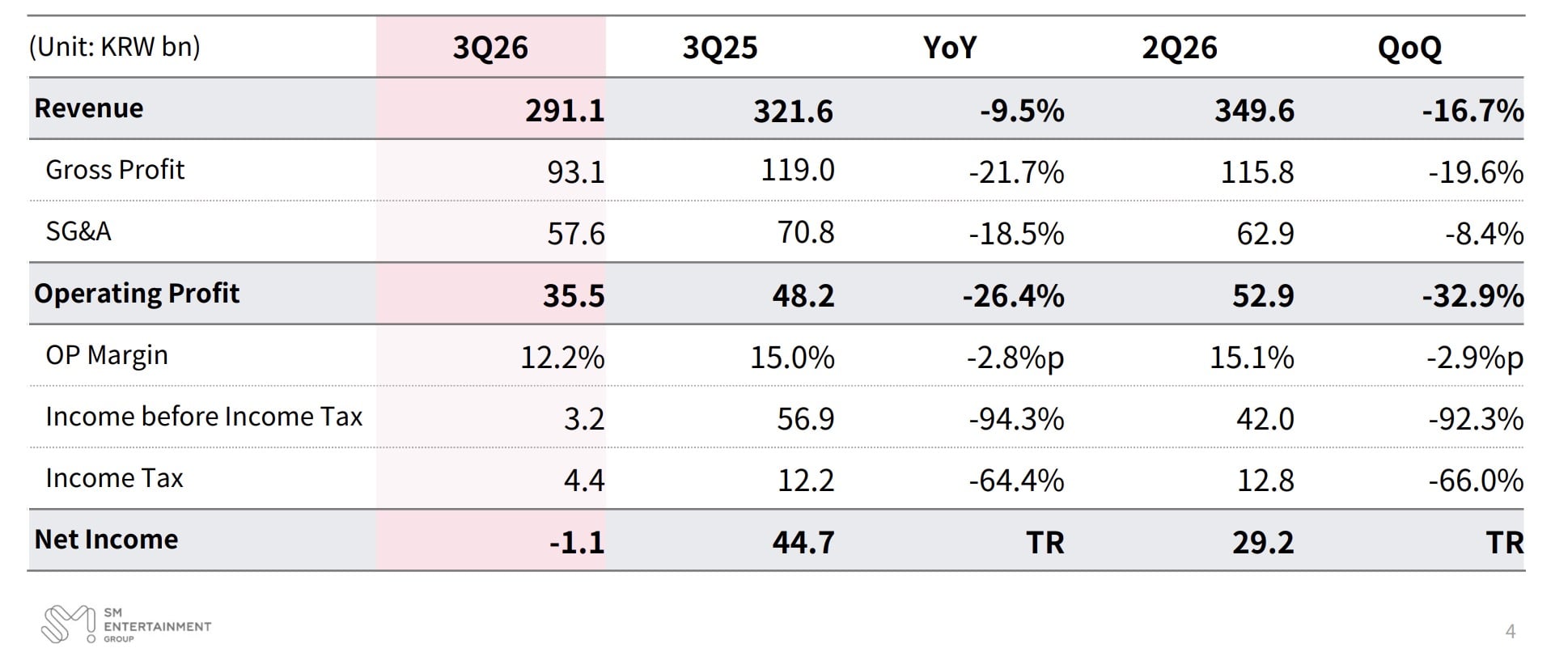
Non-operating items swung to a loss of around KRW 32.3 billion, from a gain of around KRW 8.7 billion a year earlier. As a result, pre-tax income fell 94.3% YoY to KRW 3.2 billion, which was less than the KRW 4.4 billion income tax charge SM booked for the quarter.
Year over year, SM’s other expenses rose to KRW 13.4 billion from KRW 1.1 billion, while its financial income fell to KRW 0.2 billion from KRW 4.6 billion. Its financial expenses also climbed to KRW 17.7 billion in Q3, up from KRW 9.6 billion in Q2.
HYBE also booked foreign exchange losses in its record quarter. CFO Kyung-Jun Lee said most of the company’s KRW 142.8 billion in Q3 non-operating expenses came from foreign exchange valuation losses as the won strengthened.
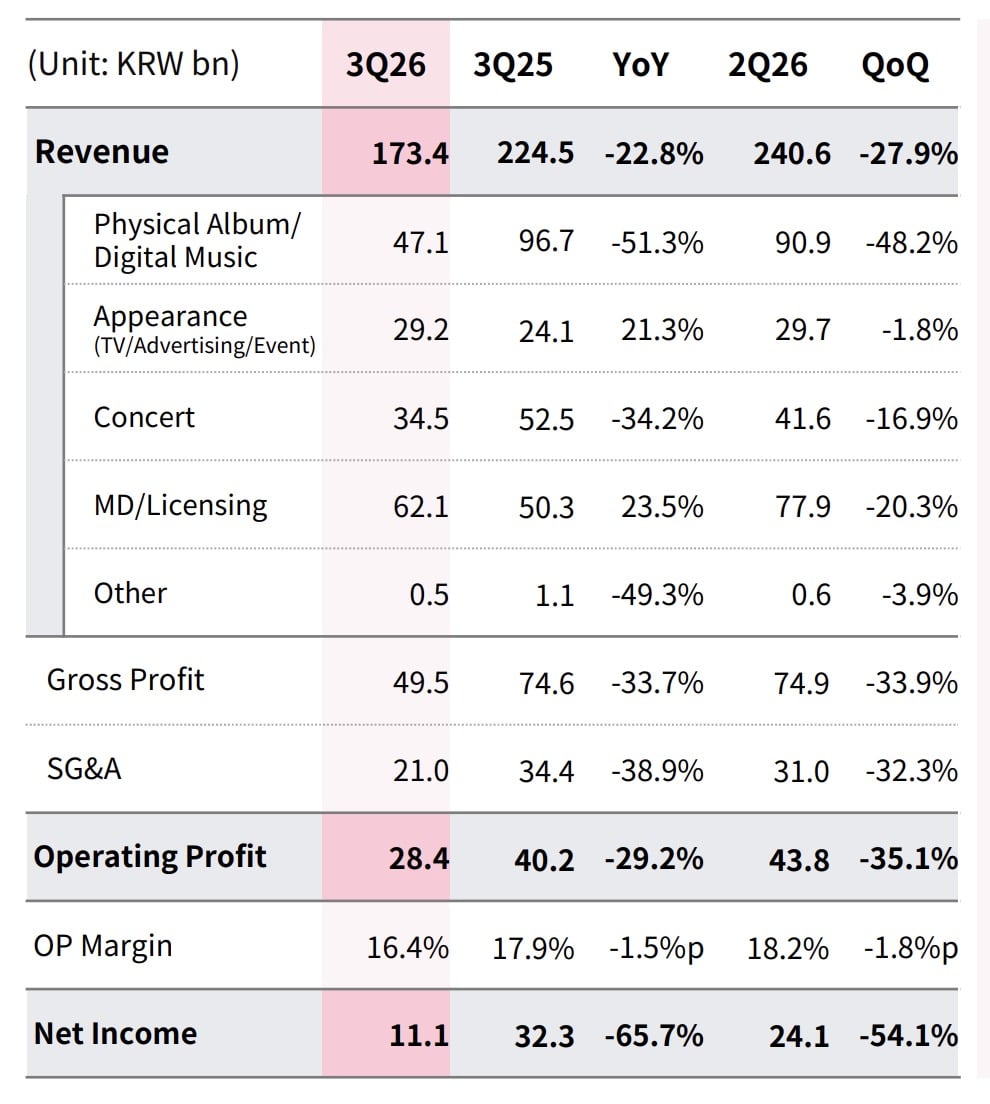
At parent-company level, SM’s revenue fell 22.8% YoY to KRW 173.4 billion ($122.2 million).
Revenue from physical albums and digital music fell 51.3% YoY to KRW 47.1 billion ($33.2 million), which SM linked to lower unit volumes for new releases.
By volume, SM sold 1.67 million copies of new-release albums in the quarter, down around 70% YoY from 5.50 million a year earlier, which the company said came “as our major artists focused on expanding their overseas activities.”
That unit count covers new-release albums only, while the KRW 47.1 billion revenue figure covers all physical albums and digital music.
Q3 volume was also down from the 5.67 million new-release copies SM sold in Q2, as previously reported by MBW.
None of SM’s Q3 releases sold a million copies. A year earlier, its third quarter was driven by million-sellers including NCT WISH’s Color, aespa’s Rich Man, and NCT DREAM’s Go Back to the Future.
The biggest Q3 release was NCT 127’s seventh full-length album, BLINGY, with 970,000 copies, followed by WayV’s Vision Wings (240,000), SUPER JUNIOR-83z’s Promise (150,000), and Red Velvet’s Velvet Summer (140,000).
Concert revenue fell 34.2% YoY to KRW 34.5 billion ($24.3 million).
SM said the decline came “as major artists expanded their global presence and held performances tailored to individual markets.”
Shows in the quarter included 13 by aespa on its world tour, 10 on TVXQ! member U-KNOW’s solo tour, eight on EXO’s sixth tour, and three on NCT 127’s fifth tour.
Merchandising and licensing revenue rose 23.5% YoY to KRW 62.1 billion ($43.8 million), making it the parent company’s largest revenue line in the quarter.
SM credited strong demand for event and concert merchandise, along with various IP collaborations.
These included a pop-up tied to NCT 127’s BLINGY, an official EXO character merchandise line called EXO-MUNGCHIZ, and a licensing collaboration between aespa and PUBG.
Some of that growth appears to reflect a shift within the group. Merchandise subsidiary SM Brand Marketing (SM BM) saw revenue fall 25.8% YoY to KRW 14.0 billion, which SM said followed “the internalization of MD planning capabilities at the parent company.”
Appearance revenue, which covers TV, advertising, and events, rose 21.3% YoY to KRW 29.2 billion ($20.6 million). SM said the growth was “driven by our artists’ increased participation in overseas award ceremonies and music festivals, as well as expanded advertising engagements with brands.”
Parent-company operating profit fell 29.2% YoY to KRW 28.4 billion ($20.0 million).
Aggregate revenue across SM’s subsidiaries rose 12.1% YoY to KRW 164.6 billion ($116.0 million).
Their combined operating profit, however, fell 9.9% YoY to KRW 12.2 billion, and they swung to a combined net loss of KRW 6.0 billion.
Revenue at SM Entertainment Japan fell 5.8% YoY to KRW 23.0 billion on a weaker yen, while its operating profit fell 89.4%, which SM said reflected “a higher proportion of artist fan meetings and smaller-scale concerts.”
Concert-production unit DREAM MAKER grew revenue 223.2% YoY to KRW 27.4 billion ($19.3 million) on more domestic and overseas concert productions.
Actor-management firm KEYEAST grew revenue 336.3% YoY to KRW 15.8 billion on new TV series production.
Album-printing unit SM Life Design Group (SM LDG), meanwhile, saw revenue fall 58.7% YoY to KRW 7.6 billion on lower print volumes.
Fan-platform subsidiary DearU, which operates messaging service Bubble, grew revenue 2.4% YoY to KRW 22.8 billion ($16.1 million), which SM attributed to new artist additions and more subscribers in China.
Across the first nine months of 2026, SM’s consolidated revenue rose 7.5% YoY to KRW 919.8 billion.
The Q3 decline followed double-digit YoY revenue growth at SM in each of the previous five quarters, including 15.4% growth in Q2.
Looking ahead, SM’s release schedule for Q4 includes full-length albums from NCT DREAM (due November 9) and TAEYEON, along with a mini album from an EXO unit.
The quarter has already brought NCT WISH’s fourth mini album, I SPY, which sold 1.56 million copies in its first week after its October 12 release, according to Hanteo Chart.
SEULGI, JAEHYUN, and RIIZE are each scheduled to release full-length albums in Q1 2027.
aespa, meanwhile, is scheduled to play nine shows across Europe in Q1 2027, including dates in Manchester, London, Berlin, and Paris.
NCT WISH has 17 shows planned across Asia in the same quarter on its second concert tour.
All KRW-USD conversions in this article were made at the average Q3 2026 exchange rate of approximately 1,419 KRW/USD, according to Bank of Korea data.Music Business Worldwide