
Spotify is cracking down on profiles of artists whose identities are generated by artificial intelligence.
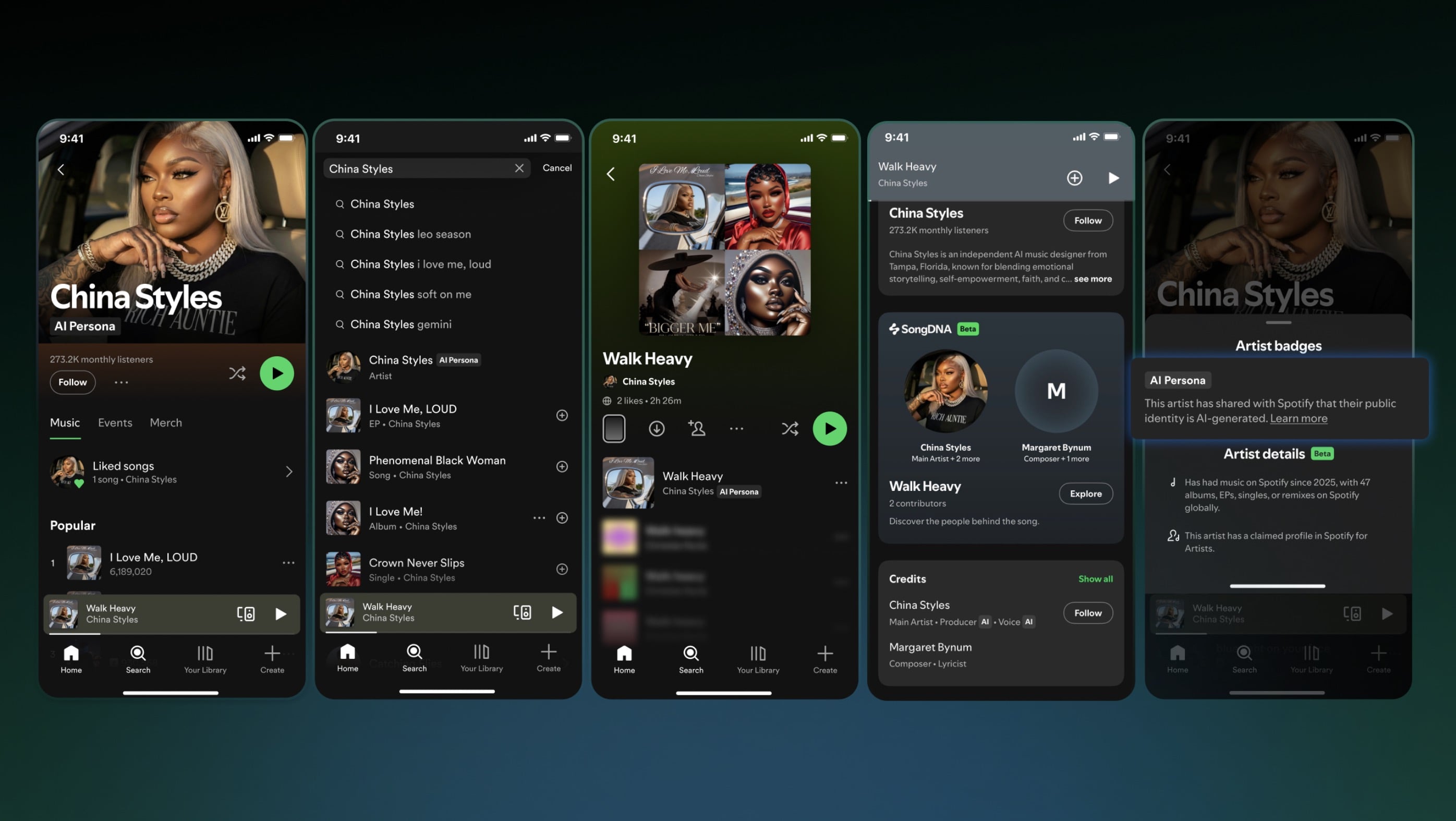
The streaming platform is introducing a badge that flags artist profiles built around an AI-generated identity as “AI Personas”.
The label is designed to tell listeners that an artist’s identity “may be AI-generated and does not represent a real person”, according to Spotify.
Music from profiles carrying it will be kept out of Spotify‘s personalized recommendations by default.
The badge will start appearing from mid-September, Spotify said in an announcement on Tuesday (August 11).
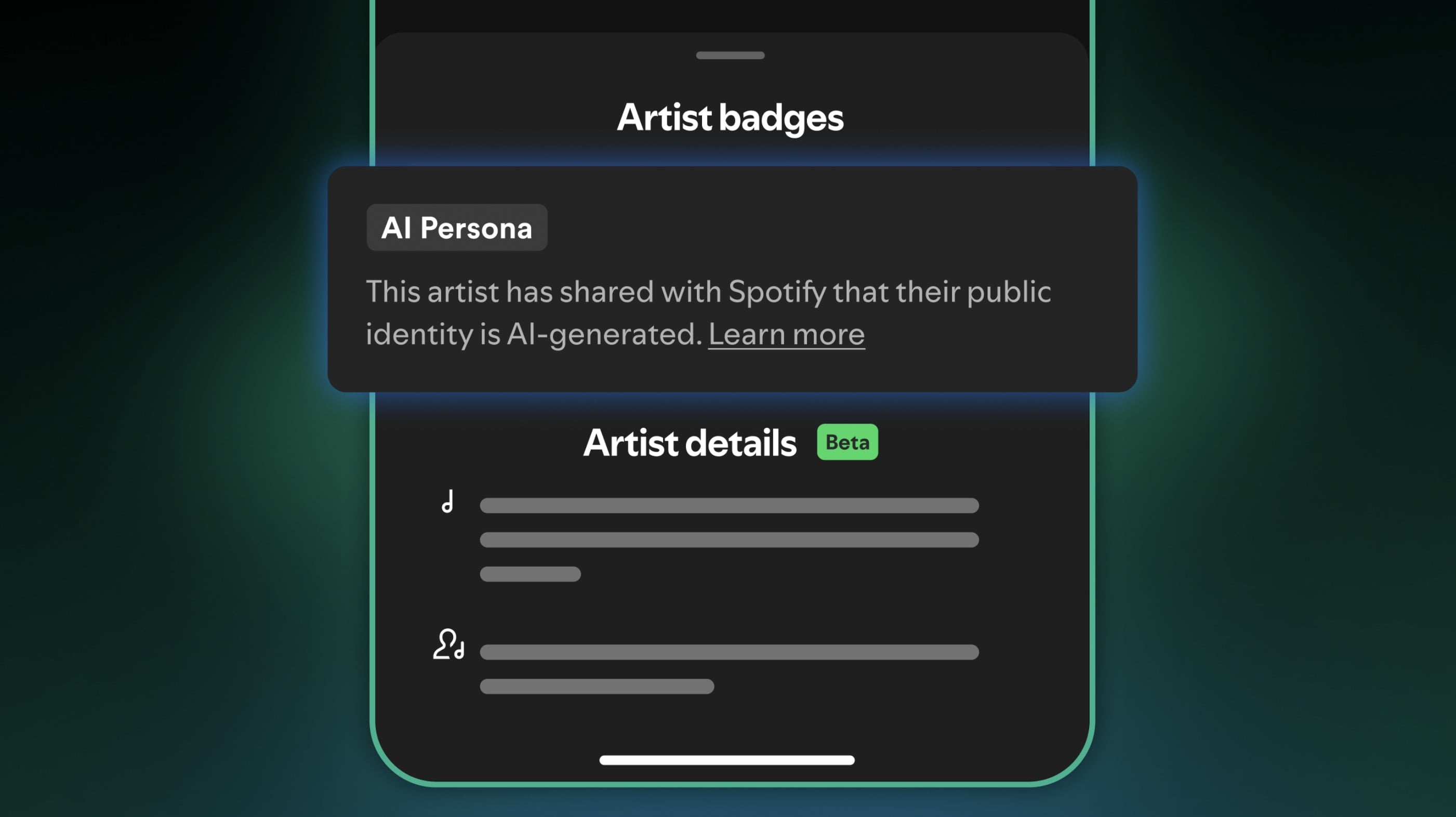
From Tuesday, artists can use Spotify for Artists to disclose that their profile represents an AI Persona.
Spotify said self-disclosure will not be the only route to the badge, and that human reviewers and “AI investigative tools” will also be used to apply it.
The company will also review profiles itself and flag those whose public identity “appears to represent photorealistic AI-generated identities”.
Spotify is starting with artists that have passed “defined audience thresholds”, so the labels reach the profiles most listeners see.
The badge is the latest step in an industry-wide push to label or restrict AI-generated music.
In July, the RIAA and IFPI proposed two voluntary tags, “AI-generated” and “AI-assisted”, to mark AI-made recordings on services including Spotify and Apple Music.
On July 29, a coalition of the three majors and independents including Believe, BMG, Concord and HYBE Corp. proposed principles to bar AI-made recordings from official charts unless they are lawfully made, ‘substantially human-made’, and free of stream-manipulation concerns.
IFPI, which represents the recording industry worldwide, has since begun applying those principles across the official charts it runs, from the Official MENA Charts to several in Latin America.
The organization says it is expanding the rollout to more than 20 further charts, including Australia’s ARIA Charts and Germany’s Offizielle Deutsche Charts.
The regulatory backdrop shifted this month, when the EU AI Act’s content-labeling rules took effect on August 2.
Those rules require whoever deploys an AI system to label deepfakes, a duty the European Commission says covers audio built to mimic a real artist’s voice.
From mid-September, Spotify’s AI Persona badge will appear on mobile on artist profiles, in the banner and About section, in Search, and on track rows across playlists.
Spotify said in a blog post: “Listeners have been clear in telling us that they don’t like seeing an artist profile that seems human, only to find out that the persona is AI-generated.”
Music from AI Personas will not be included in any of Spotify‘s editorial or algorithmic recommendations by default, unless a listener chooses to follow the AI Persona, for example.
“While we believe all artists have creative choice in determining how they present themselves, Spotify’s programming is focused on elevating music from authentic artists building careers in music,” Spotify said.
Where Spotify‘s review team applies the badge, the affected artist will be notified and can then self-disclose or appeal.
Spotify added that within months, listeners will also be able to report profiles they suspect are AI Personas.
Spotify said the badge concerns an artist’s public identity, meaning the name and imagery on their profile, rather than how their music was made.
“Although there’s a broad spectrum in how artists use AI as a creative tool, the question of whether a profile represents an actual human is one where Spotify can help make a clear determination,” Spotify said.
For more on how a track was made, the company pointed to its AI Credits and SongDNA features.
Spotify said: “We know the music ecosystem is evolving, and so will our approach.”
Spotify said in September 2025 that it had removed more than 75 million “spammy” tracks over the prior year, as it brought in rules against impersonation and AI-enabled fraud.
As part of the same policy package, it committed to supporting a new DDEX standard for AI disclosures in music credits.
In April, Spotify began showing AI Credits in Song Credits, disclosing AI use where an artist shares it through a label or distributor.
Also in April, it introduced a verification badge for artist profiles and said that “at launch, profiles that appear to primarily represent AI-generated or AI-persona artists are not eligible for verification”.
France’s Deezer says it was the first streaming service to detect and tag AI music at the platform level, back in 2025.
Deezer said fully AI-generated tracks made up more than half of its daily uploads for the first time in June, at close to 90,000 a day.
That was up from 75,000 a day, or 44% of uploads, in April.
The company says up to 85% of streams on fully AI-generated music were fraudulent in 2025, and that it strips those from royalty payments.
Block-owned TIDAL set out a policy in June to tag tracks it identifies as fully AI-generated and stop them earning royalties.
High-fidelity rival Qobuz announced its own detection system in February, saying it would tag AI-generated tracks and remove those found to be impersonating artists or manipulating streaming activity.
Apple Music, meanwhile, launched a tagging system in March that relies on labels and distributors to declare AI-generated content, rather than detecting it at the platform level.Music Business Worldwide