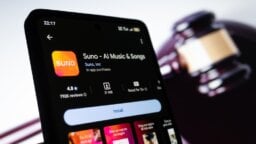
Suno is fighting to make Apple answer questions, under oath, about whether Apple Music could survive without the catalogs of Universal Music Group and Sony Music.
The AI music company set out its case in a filing on Tuesday (October 27), opposing Apple’s bid to block the deposition subpoena.
Suno’s filing, reviewed by MBW, can be read in full here.
Suno also wants an Apple witness to testify about Apple’s current licensing talks with both majors, streaming fraud on Apple Music, and what the labels have told Apple about Suno.
Apple, which is not a party to the case, asked a federal court in California on October 13 to block the demand, arguing that the topics are “irrelevant, overbroad, and disproportionate to the needs of the case.”
Suno argues that UMG and Sony themselves put Apple Music at the center of the case.
The fight stems from the copyright lawsuit that UMG and Sony are pursuing against Suno in Massachusetts federal court, which accuses the company of training its AI on the labels’ recordings without permission.
That case, first filed in June 2024, covers 560 recordings.
The labels are seeking up to USD $150,000 per work infringed – a theoretical maximum of around USD $84 million – plus up to USD $2,500 for each alleged act of circumventing YouTube’s anti-downloading technology, as previously reported by MBW.
UMG and Sony sued Suno a second time in September, over 60,202 further recordings that would carry a theoretical maximum of just over USD $9 billion at the same per-work ceiling.
Warner Music Group, originally a co-plaintiff, settled with Suno in November 2025.
According to Suno’s filing, the labels allege that music made by Suno users is “flooding streaming services like Apple Music, ‘eroding’ Plaintiffs’ market share and ‘diluting’ the royalty pools those services pay out.”
“Apple now asks the Court to prevent Suno from asking Apple a single question on these exact issues,” the filing states.
“Apple casts itself as a bystander whose ‘sole connection’ to this case is that its service is one of several places where music ‘can be played.’ … But Plaintiffs made Apple Music central to this case.
“Plaintiffs’ complaint explicitly names Apple Music as a destination for Suno outputs.
“Apple casts itself as a bystander whose ‘sole connection’ to this case is that its service is one of several places where music ‘can be played.’ … But Plaintiffs made Apple Music central to this case.”
Suno’s opposition brief
“Plaintiffs’ theory of market harm depends on what happens on platforms like Apple’s, one of the labels’ biggest digital music partners. Plaintiffs have also focused on Apple specifically in their campaign to eliminate or demonetize AI-generated music across all music streaming platforms.”
Suno has agreed to accept a written sworn statement from Apple on five of the nine topics in its original demand.
It is still seeking live testimony on four: Apple’s current licensing negotiations with the two labels; whether Apple has assessed running Apple Music without one or both of their catalogs; streaming fraud on the service; and Apple’s communications with the labels, or their trade body the RIAA, about Suno and the case.
Suno says those topics go to two of its defenses.
The first is fair use – Suno’s argument that training its AI on the labels’ recordings was lawful. A key test is whether that use harmed the market for the original works.
Suno’s filing says the labels’ deals with Apple set how their royalties are calculated, covering “things like guaranteed minimum royalties (which are paid regardless of whether AI content is or is not present in the market) and contractual provisions that specifically exclude AI-generated content from the royalty pool (meaning that, mathematically, AI content cannot ‘dilute’ Plaintiffs’ royalties).”
Apple’s motion, however, states that the company “does not currently exclude AI-generated content from its royalty pool.”
Suno also points to comments by UMG Chief Digital Officer Michael Nash on the company’s earnings call in March, where he cited “anti-AI dilution provisions in numerous UMG agreements.”
Nash told investors on the same call that UMG was “seeing no indication that AI royalty dilution is a material issue for UMG from a revenue perspective.”
Suno’s second defense is copyright misuse – the argument that a rightsholder has used its copyrights to win concessions beyond what copyright law protects.
“The core of Suno’s copyright misuse defense is that Plaintiffs use their copyright monopoly and ‘must have’ catalog as a cudgel to extract broad, anti-AI concessions from DSPs,” the filing argues. “Plaintiffs’ response is to assert that their crusade to extract anti-AI provisions from every DSP is, in fact, just a well-intentioned attempt to combat ‘streaming fraud.’”
Suno notes that the labels’ own complaint states they are “not presently alleging” that Suno’s outputs infringe their recordings.
On the same March earnings call, Nash cited Apple’s anti-fraud efforts: “Apple recently reported that its efforts to address the flood of AI uploads included exclusion of 2 billion fraudulent streams last year.”
Suno argues that “because Apple – not Plaintiffs – actually confronts streaming fraud, only Apple can say whether the fraud it encounters is in fact related to AI-generated content.”
Suno says it will leave the technical details of Apple’s fraud-detection methods out of the questioning.
On whether Apple Music could operate without the majors, Suno writes: “A copyright holder whose catalog is easily replaced has little ability to extract concessions beyond the scope of its copyright; one whose catalog is a ‘must have’ has a great deal.
“Plaintiffs will surely contend at trial that they could not possibly ‘misuse’ their copyrights against a company as large and powerful as Apple. Suno is entitled to test that contention against Apple’s own view of how essential Plaintiffs’ catalogs are to Apple Music…”
Suno sets that against UMG’s own claim to investors that its catalog is “the biggest driver of new subscribers to the DS[Ps].”
“This isn’t just bluster: in early 2024, UMG pulled all of its content from TikTok in part because TikTok would not capitulate to UMG’s demands regarding AI content on the platform, and UMG did not allow its content to return to TikTok until those demands and others were met,” the filing says.
Apple says it has responded to six subpoenas from the labels and Suno over more than a year, producing data on millions of tracks on Apple Music.
Apple calls Suno’s questions about the viability of Apple Music without the majors “a fishing expedition by a new entrant to the music industry to gain insight into Apple’s business operations.”
Apple also argues that its licensing negotiations and AI strategy would be at risk in a case “populated by Apple’s licensing counterparties and competitors.”
“Plaintiffs and Defendant have dragged in the entire music industry by issuing subpoenas to Apple’s DSP competitors (such as Spotify, Amazon, and Pandora) and unrelated industry bodies like the Mechanical Licensing Collective,” the motion says.
Suno says it served only two of the subpoenas Apple counts, adding: “If the record demonstrates anything, it is that Suno approached this process collaboratively and constructively, while Apple largely stonewalled.”
On confidentiality, Suno says any testimony could be marked “Highly Confidential – Outside Counsel Only” under an order already in place in the case, “so that no one at Suno would ever see it.”
Apple’s motion further discloses that the company deployed its own AI-generated music detection tool in March 2026, and gave the parties a spreadsheet of tracks it identified as Suno-generated, including play counts.
For the consumer-facing “Made With AI” labels it outlined to partners in August, Apple Music is relying on record labels and distributors to tag tracks, as MBW reported.
If the court grants Suno’s request, Apple would have to put forward a witness on all four topics, including its current negotiations with two of the three major record companies.
A hearing on Apple’s motion is scheduled for December 1 before Magistrate Judge Virginia K. DeMarchi.Music Business Worldwide